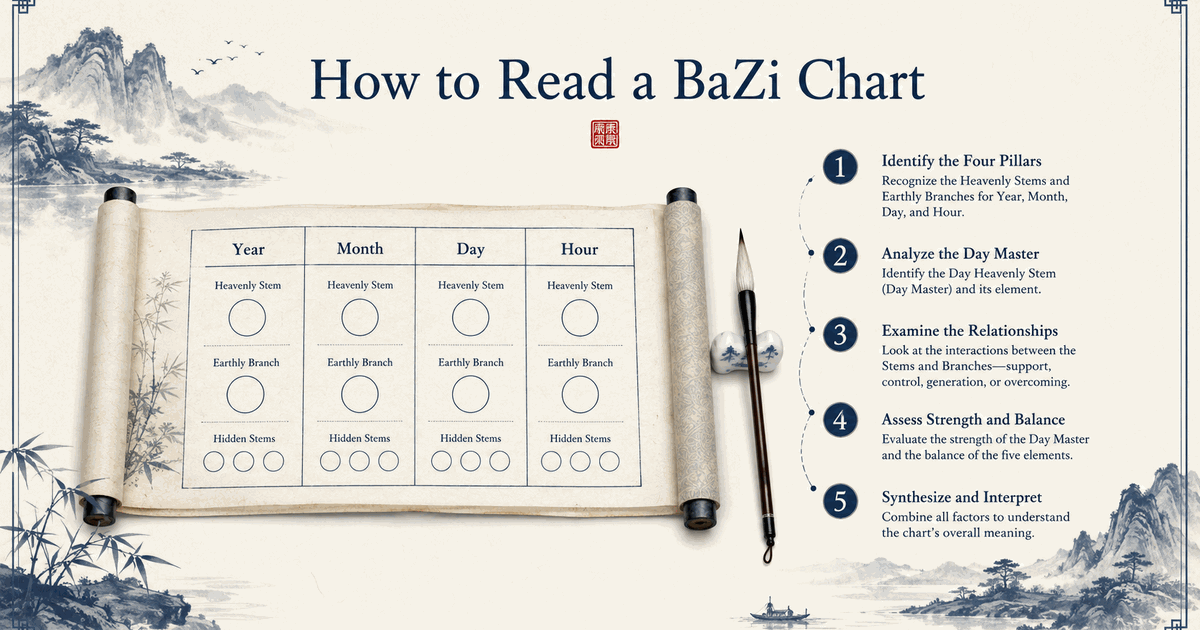
By the end you will be able to look at your own Four Pillars and answer four questions in order: Who is the chart about? What is it made of? Is it balanced? And how does timing move through it? Everything in a reading is built on that sequence.
What a BaZi Chart Shows
A BaZi chart is a snapshot of the moment you were born, written in the old Chinese calendar. It has four columns, called the Four Pillars: Year, Month, Day, and Hour. Each pillar has two parts stacked on top of each other — a Heavenly Stem on top and an Earthly Branch below.
That is eight characters in total, which is what "BaZi" means — literally "eight characters." Each character carries one of the Five Elements and a yin or yang polarity. So the whole chart is really a small map of how five kinds of energy are arranged and balanced at your moment of birth.
| Hour | Day | Month | Year | |
|---|---|---|---|---|
| Stem | 甲 | 丙 | 辛 | 戊 |
| Branch | 午 | 子 | 酉 | 辰 |
Read the day column first, then the others. The next steps explain why.
Step 1 — Find Your Day Master
The single most important character is the Heavenly Stem of the Day pillar. This is your Day Master — it represents you. In the example above, the Day Master is 丙 (Yang Fire).
Everything else in the chart is interpreted relative to this one character. Before you analyse anything, identify your Day Master and note its element and polarity. There are only ten possibilities, five elements in yang and yin form, so this step is quick once you know where to look. If you do not know your chart yet, the free calculator finds your Day Master instantly.
Step 2 — Weigh the Five Elements
Next, count what the chart is made of. Look across all eight characters and see which of the Five Elements — Wood, Fire, Earth, Metal, Water — appear often, and which are missing or scarce. This is not about a rigid tally; the month branch carries far more weight than a single stem, because it sets the season.
The elements relate through two cycles you should know:
- Generating cycle: Wood feeds Fire, Fire makes Earth, Earth bears Metal, Metal holds Water, Water grows Wood.
- Controlling cycle: Wood parts Earth, Earth dams Water, Water quenches Fire, Fire melts Metal, Metal cuts Wood.
These cycles are how you judge whether an element is being supported or spent. A Fire Day Master born in a Metal-heavy autumn month, for example, sits in a season that does not feed it. Hold that thought — it matters for the next step.
Step 3 — Judge Day Master Strength
Now ask: is the Day Master well-supported, or is it stretched thin? This is Day Master strength, and it is the pivot of the whole reading. Support comes from the same element (allies) and from the element that produces yours (Resource), and above all from a favourable season. It is drained by what you produce (Output), what you control (Wealth), and what controls you (Officer).
Weigh those against each other and you land on a rough verdict: strong, weak, or balanced. Resist the urge to read this as a report card. A "weak" Day Master is not a weak person — it simply means the chart benefits from support rather than more output. Strength exists only to tell you the next thing: which elements bring the chart back toward balance. Those are your favourable elements, and they colour everything that follows.
Step 4 — Read the Ten Gods
With the Day Master and its balance clear, you can now read relationships. Every other character is labelled by how it relates to your Day Master, and those labels are the Ten Gods. There are five relationships — same element, what you produce, what you control, what controls you, what produces you — each split into two by polarity.
The Ten Gods turn a pile of elements into a portrait of temperament. A chart weighted toward Output tends to be expressive and creative; one weighted toward Officer leans toward structure, duty, and responsibility; heavy Resource points to a person who learns and leans on support. Read them together, not one at a time — the mix is the message. And keep the framing honest: these describe how you are wired to engage, not events that are fated to occur.
Step 5 — Add Timing with Luck Pillars
The natal chart is fixed, but you also move through Luck Pillars — ten-year cycles that change which elements are emphasised around you. A decade that brings in one of your favourable elements tends to feel like expansion; one that piles on an element you already have in excess can feel like friction.
The key is to treat a Luck Pillar as context, not verdict. It changes the weather over a fixed landscape. Used well, it tells you which seasons suit building, which suit consolidating, and which suit rest — a lens for better decisions, never a script you are forced to follow.
A Worked Example
Take the sample chart above: a 丙 (Yang Fire) Day Master born in the 酉 (Metal) month. Fire is not supported by an autumn Metal season, and there is Water sitting in the day branch (子) that works against Fire. On a first pass, this reads as a Fire Day Master that is not strongly rooted — leaning weak.
That single judgment already does useful work. It suggests the chart is steadied by Wood (which feeds Fire) and by Fire allies, and that heavy Water or Metal periods will feel more demanding. From there, the Ten Gods add the texture — how this person tends to express, work, and relate — and the Luck Pillars tell you when the surrounding elements shift. Notice we never predicted an event; we described a pattern and its balance.
The order never changes: who the chart is about, what it is made of, whether it is balanced, and how timing moves through it. Master that sequence and any chart becomes readable.
Common Mistakes Beginners Make
- Reading "weak" as bad. Strength is a balance state, not a score. Both strong and weak charts work well once you know their favourable elements.
- Counting elements like a checklist. The season (month branch) outweighs a lone stem. Position and roots matter more than raw tallies.
- Jumping to the Ten Gods first. They only make sense after you have fixed the Day Master and its strength.
- Treating Luck Pillars as fortune. They shift context, not destiny. A "good" pillar is one that restores balance for your chart, not a universal lucky decade.
- Ignoring an unknown birth hour. If the time is uncertain, mark hour-dependent conclusions as tentative rather than pretending they are solid.
When to Go Beyond the Free Chart
The free calculator gives you the structure: pillars, Day Master, element balance, and a first read on strength. That is genuinely enough to understand the shape of your chart. A deeper reading is worth it when you want the reasoning joined up — how the Ten Gods, strength, and timing interact into a coherent picture of temperament and the current season — written out rather than pieced together yourself.
Start free, learn the sequence above on your own chart, and only reach for a full reading when you have a specific question the structure alone does not answer.
Frequently Asked Questions
Do I need my exact birth time to read a BaZi chart?
The hour pillar needs your birth time, so without it you lose one of the four pillars. You can still read the year, month, and day pillars, and the Day Master itself comes from the day, which most people know. Treat hour-dependent details as less certain when the time is unknown.
What is the most important part of a BaZi chart?
The Day Master, the Heavenly Stem of the day pillar. It represents you, and every other element is interpreted by how it relates to it. Reading a chart starts by locating the Day Master and then weighing what supports or drains it.
Is a strong Day Master better than a weak one?
No. Strong and weak are balance states, not grades. A strong Day Master has energy that wants an outlet; a weak one benefits from support. Neither is good or bad. The useful question is which elements bring the chart back toward balance.
Can BaZi predict my future?
BaZi is best used as a map of patterns and temperament, not a forecast of events. Luck Pillars describe changing context, like seasons, rather than fixed outcomes. Tengyunzi reads a chart for self-knowledge and timing awareness, not fortune-telling.
How long does it take to learn to read a BaZi chart?
You can read the basic structure — your Day Master and element balance — in an afternoon. Reading the Ten Gods and timing fluently takes longer. Starting with a free chart and one concept at a time is the fastest way to build real understanding.