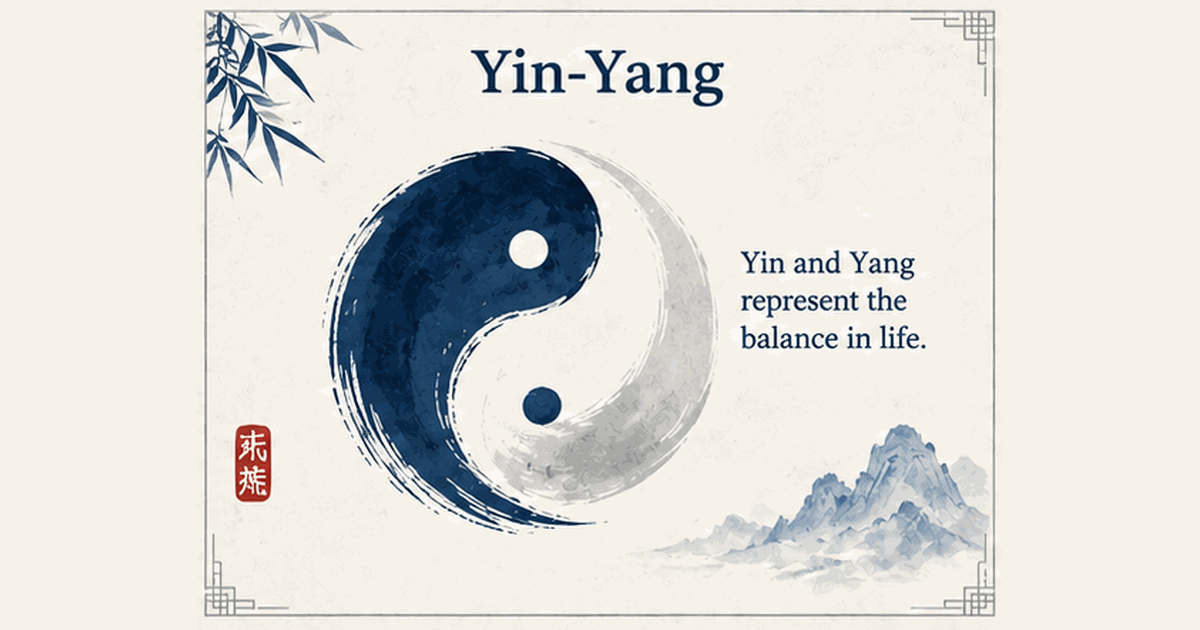
Yin and yang are the oldest idea in Chinese thought, and they sit quietly underneath every BaZi chart. Before an element is Wood or Water, before a stem has a name, it is either yang or yin. Understanding this one distinction changes how you read everything that follows, because it is the difference between knowing someone's element and knowing how they actually express it.
In plain terms: yang tends to be more direct, outward, initiating, and visible; yin tends to be more subtle, receptive, adaptive, and interior. Day turns to night, activity to rest, speech to silence. Neither half is the whole; each contains the seed of the other, which is why the classic symbol shows a dot of light inside the dark and a dot of dark inside the light.
Polarity, Not Ranking
The most common mistake beginners make is to treat yang as strong and good, yin as weak and lesser. It is worth unlearning early. Yang is not better than yin, and yin is not weaker than yang — they describe two different ways energy behaves, both necessary and both capable of strength.
A yang expression pushes and initiates; a yin expression yields and adapts. Water wears down stone precisely by being soft. In a chart, an excess of yang can read as forceful but brittle, while an excess of yin can read as flexible but unanchored. Balance, as always in BaZi, is the point — not a preference for one pole.
Five Elements, Ten Expressions
Here is where yin and yang do their real work in a chart. Each of the Five Elements splits into a yang and a yin form, and that is exactly how five elements become the ten Heavenly Stems and the ten Day Masters.
| Element | Yang form | Yin form |
|---|---|---|
| Wood | 甲 tall tree | 乙 vine or flower |
| Fire | 丙 sun | 丁 candle |
| Earth | 戊 mountain | 己 garden soil |
| Metal | 庚 axe | 辛 jewelry |
| Water | 壬 ocean | 癸 mist |
Look down the columns and the pattern is clear: the yang form is larger, more outward, more forceful; the yin form is smaller, more refined, more contained. Yang Fire is the sun that lights a sky; yin Fire is the candle that warms a room. Same element, two temperaments.
How It Changes a Reading
This is why two people can share the same element and still read very differently. Both may be Wood Day Masters, yet Yang Wood (甲) stands tall and unbending like a tree, while Yin Wood (乙) reaches and adapts like a vine. The element is shared; the polarity changes the whole style of how it moves through life.
Polarity also shapes the Ten Gods. When two characters share the same polarity, their relationship reads as steadier and more conventional; when they differ, it reads as sharper and more dynamic. This is the difference between a "proper" and an "eccentric" version of the same relationship — same structure, different temperature.
A Word on the Symbol
The familiar black-and-white taijitu is worth reading carefully, because it encodes the whole idea. The two halves are not at war; they flow into each other in a curve, and each carries a seed of its opposite. That is the point: nothing is purely yang or purely yin. At its peak, yang already begins turning toward yin, the way the longest day of summer is also the moment the light starts to shorten. In a chart, this is why extremes rarely last and why balance, not dominance, is the healthy state.
Reading Yin and Yang Together
You do not judge a chart on yin-yang alone, but it colours everything. A chart heavy in yang stems with yang branches beneath tends toward momentum and visibility; one weighted to yin leans toward depth and endurance. Most people are a mix, and the interesting readings live in how the two balance and where they tip.
Treated this way, yin and yang stop being a mystical slogan and become a practical lens: they tell you not just what someone is made of, but the rhythm in which they express it. To see how this fits into the full method, read how to read a BaZi chart.
Yin and yang are the rhythm of the chart: push and receive, reveal and conceal, begin and refine.