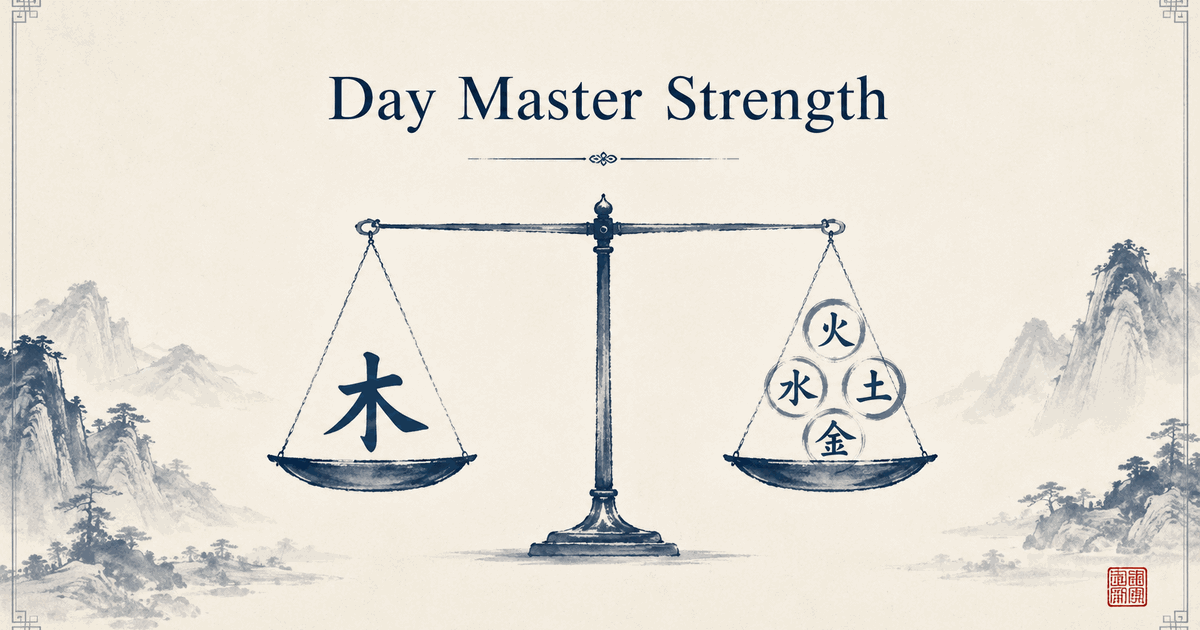
"Strong" and "weak" are two of the most misread words in BaZi. A beginner sees "weak Day Master" and assumes it means a weak person, a worse chart, a harder life. It means none of those things. Day Master strength is a technical, structural reading — and understanding what it actually measures is the step that unlocks the rest of an accurate interpretation.
What Strength Measures
Day Master strength measures one thing: how well-supported your Day Master is by the rest of the chart. Three factors dominate — the season of birth (the month branch), whether the Day Master has roots in the Earthly Branches, and how many allied and supporting elements surround it.
Read that list again and notice what is absent: willpower, character, intelligence, luck. Strength is structural, not moral. A "weak" Day Master is simply one that is less reinforced by its chart — not a weak human being. Some of the most capable charts are, in technical terms, weak.
What Adds and What Drains
The chart is a balance of forces. Some elements reinforce the Day Master; others spend it. The month of birth carries the most weight of all, because it sets the seasonal energy the whole chart sits inside — a Fire Day Master born in summer starts strong; the same Fire born in winter starts drained.
| Adds support | Draws it down |
|---|---|
| Same element (allies / Companions) | Output (what you produce) |
| Resource (what produces you) | Wealth (what you control) |
| A supportive season | Officer (what controls you) |
These supporting and draining forces are exactly the Ten Gods seen from the angle of energy: allies and Resource pour in, while Output, Wealth, and Officer draw out. Weigh the two sides, with the season counting double, and you arrive at a verdict of strong, weak, or balanced.
Strong Is Not Good, Weak Is Not Bad
This is the part worth slowing down for. Both strong and weak are balance states, not grades. A strong Day Master has ample energy that wants an outlet — it does well when the chart gives it something to do, and can feel restless or domineering when it does not. A weak Day Master benefits from support and consolidation — it thrives with backing and structure, and can feel stretched when overloaded.
Neither is a prize or a penalty; they are just different starting conditions that call for different things. The useful question is never "did I pass?" It is "which elements bring my chart back toward balance?"
Strength is a balance reading, not a scorecard. The point is knowing what your chart leans toward — not whether you "pass."
From Strength to Favourable Elements
Here is why this step matters so much: strength is what points to your favourable elements. If a Day Master is too strong, the elements that gently drain and channel it — Output, Wealth, Officer — become favourable, giving the excess somewhere to go. If it is too weak, the elements that support it — allies and Resource — become favourable, shoring it up.
Those favourable elements then colour the entire reading: which Luck Pillars feel supportive, which pursuits suit you, which habits and environments steady you. Get strength wrong and everything downstream tilts the wrong way, which is why practitioners spend real care here.
An Analytical Step, Not a Judgment
Treat Day Master strength as the hinge of the reading, not a verdict on you. It is the analytical move that turns a chart from a list of elements into something specific — a chart that leans a particular way and is steadied by particular things. Knowing which way yours leans is what makes everything after it personal rather than generic. To see where this fits in the full sequence, read how to read a BaZi chart.