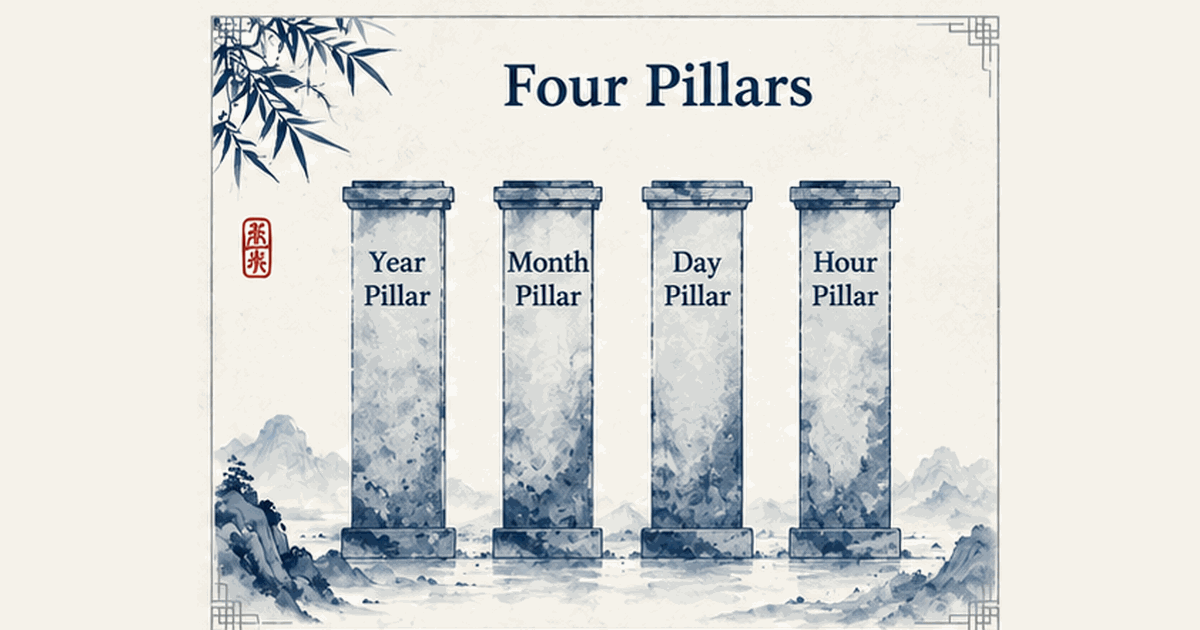
The Four Pillars of Destiny — Si Zhu in Chinese — are the frame on which every BaZi reading hangs. A chart contains four vertical columns, each with a top and a bottom character. Together they form eight characters, which is why BaZi literally means "eight characters." Once you see how the four columns are organised, the chart stops being intimidating and starts being readable.
The four pillars come from the four parts of your birth moment: the year, the month, the day, and the hour, all converted into the old Chinese sexagenary calendar. Each pillar is a snapshot of the energy present at that level of time, and each speaks to a different layer of life.
What Each Pillar Represents
Read left to right, the pillars move from the outer, inherited layers of life toward the inner and later ones. A rough map:
| Pillar | Common life area | How to read it |
|---|---|---|
| Year | Background, ancestry, public layer | Context and early environment |
| Month | Career, parents, season | The strongest environmental force |
| Day | Self and intimate life | The Day Master sits here |
| Hour | Later life, children, output | Private aspiration and long-range direction |
These life areas are traditional associations, not fixed predictions. They tell you where to look, not what will happen. The Month pillar deserves special attention: because it sets the season of birth, it carries the most weight in judging the balance of the whole chart.
Stem and Branch
Each pillar stacks two characters. On top sits a Heavenly Stem, which shows the visible, outward elemental expression — the part of you the world sees readily. Below sits an Earthly Branch, which is deeper, more seasonal, and tied to the twelve zodiac animals and the hours of the day.
Branches also carry hidden stems — additional elements tucked inside them that do not show on the surface. This is one reason BaZi is far more layered than a simple zodiac sign: a single branch can hold two or three influences at once, and a skilled reading weighs them all. Every character, stem or branch, carries one of the Five Elements in a yang or yin form.
Why the Day Master Matters
Of all eight characters, one is the reference point for everything else: the Heavenly Stem of the Day pillar, called the Day Master. It represents you. Every other symbol in the chart is interpreted by how it relates to this single character — whether it supports it, drains it, or controls it.
This is why two people with similar-looking pillars can read very differently: change the Day Master and the same surrounding elements take on entirely new meanings. The whole system of the Ten Gods is built on these relationships to the Day Master.
The chart is not a pile of symbols. It is a relationship map centred on the Day Master.
Reading the Pillars Together
Individually the pillars are just labels. The reading happens when you look at how they interact — which elements repeat across pillars, which support the Day Master, which press on it, and how the season tilts the balance. A strong showing of one element in three pillars means something quite different from the same element appearing once.
If you want to see this in practice, the step-by-step method is set out in how to read a BaZi chart, which walks a sample chart from the Day Master through to timing.
What If You Don't Know Your Birth Hour?
A surprising number of people know their birth date but not the exact time. Because the Hour pillar depends on the time, an unknown hour means you are reading three pillars instead of four. That is not a dead end: the Year, Month, and Day pillars still stand, and crucially the Day Master — the anchor of the whole reading — comes from the Day pillar, which you have.
The honest approach is to read what you can confidently and treat hour-dependent themes — later-life direction, children, private aspiration — as tentative rather than fixed. A good reading is transparent about this rather than inventing a precise hour to fill the gap.
What to Learn Next
Once the Four Pillars are clear, the natural next layer is the Five Elements and their cycles, followed by the ten Day Masters and the Ten Gods. Each builds on the pillar structure you now understand, so this is the right foundation to have laid first. When you are ready to put it all together, how to read a BaZi chart walks the full sequence end to end.