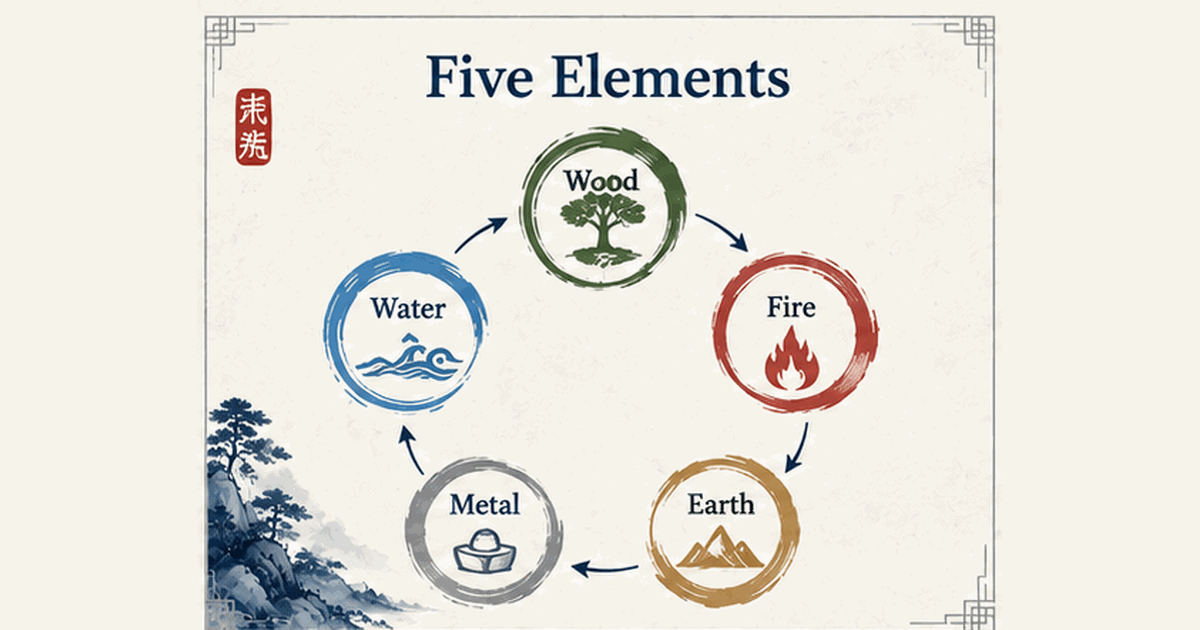
The Five Elements — Wood, Fire, Earth, Metal, and Water — are the vocabulary of BaZi. Every character in a Four Pillars chart carries one of them, and almost everything a reading says is really a statement about how these five behave together. Get comfortable with the elements and the rest of BaZi stops looking like a wall of foreign symbols.
One thing to set straight first: in Chinese the term is Wu Xing, which is closer to "five movements" or "five phases" than "five elements." They are not building blocks of matter like the periodic table. They are five modes of change — five ways energy tends to move. Wood is not literally wood; it is the quality of growth and reaching outward. Keeping that in mind stops a lot of confusion later.
What Each Element Represents
Each element describes a direction of movement and a matching set of tendencies in temperament. None is better than another; they are simply different ways of engaging with the world.
| Element | Symbolic movement | Temperament it tends toward |
|---|---|---|
| Wood | Growth, expansion | Learning, planning, kindness, ambition to build |
| Fire | Illumination, rising | Expression, warmth, visibility, enthusiasm |
| Earth | Containment, settling | Trust, care, stability, responsibility |
| Metal | Refinement, contraction | Standards, discipline, clarity, precision |
| Water | Flow, descent | Wisdom, memory, strategy, adaptability |
Each element also splits into a yang and a yin form, which is how five elements become the ten Heavenly Stems. If that idea is new, the article on yin and yang explains why the same element can express so differently in two people.
The Generating Cycle
The elements are not a static list. They feed and drain each other in two cycles, and understanding those cycles is what turns a pile of symbols into a reading. The first is the generating cycle, sometimes called the productive or mother-child cycle:
Wood feeds Fire, Fire creates Earth (ash), Earth bears Metal (ore), Metal carries Water (condensation), and Water nourishes Wood. Each element produces the next, so it describes support, resource, and growth. When one element is strong, it tends to strengthen whatever it generates — a chart rich in Water, for example, quietly supports its Wood.
In a reading this cycle answers questions like: what feeds this person, what do they lean on, and what do they pour their energy into? It is also the basis of the Resource and Output relationships in the Ten Gods.
The Controlling Cycle
The second cycle is the controlling — or overcoming — cycle: Wood parts Earth (roots break soil), Earth dams Water, Water quenches Fire, Fire melts Metal, and Metal cuts Wood. Each element restrains the one it controls.
It is tempting to read "control" as conflict, but that is the wrong frame. Control is what creates structure and keeps any single element from running away with the chart. A Fire that is never checked burns out; a little Water gives it shape. The controlling cycle is where discipline, boundaries, and pressure live — necessary, in the right measure.
How the Elements Show Up in a Chart
When you calculate your chart, the eight characters distribute across the five elements unevenly. Some elements appear several times, some once, some not at all. The first pass of any reading is simply noticing this spread, weighted heavily by the birth month, which sets the season and therefore the dominant energy.
From there the two cycles do the work: an element that is generated and unopposed grows strong; one that is controlled and unsupported stays weak. That balance of strong and weak against your Day Master is what a reading interprets. The full method is laid out step by step in how to read a BaZi chart.
Balance and Favourable Elements
A favourable element is not simply the one you have least of. It is the element that helps the whole chart function with more balance — sometimes by adding what is scarce, sometimes by draining what is in excess. This is why the same element can steady one person's chart and overload another's.
It is also why BaZi resists simple prescriptions. Two people can both be "short on Fire" and need completely different things, because the surrounding elements differ. Balance in BaZi is relational, not a checklist.
A Common Misunderstanding
Perhaps the most widespread myth is that a "missing" element is a flaw to be fixed. A chart with no visible Water is not broken, and the goal is not to collect all five like a set. Many strong, well-functioning charts are missing an element entirely; what matters is how the elements that are present interact, and whether the balance serves the Day Master.
Treated this way, the Five Elements stop being a fortune-telling gimmick and become what they were meant to be: a precise, humane language for describing how a person is inclined to move through the world.
In BaZi, balance is relational. The question is never which element you have, but how the elements behave together.