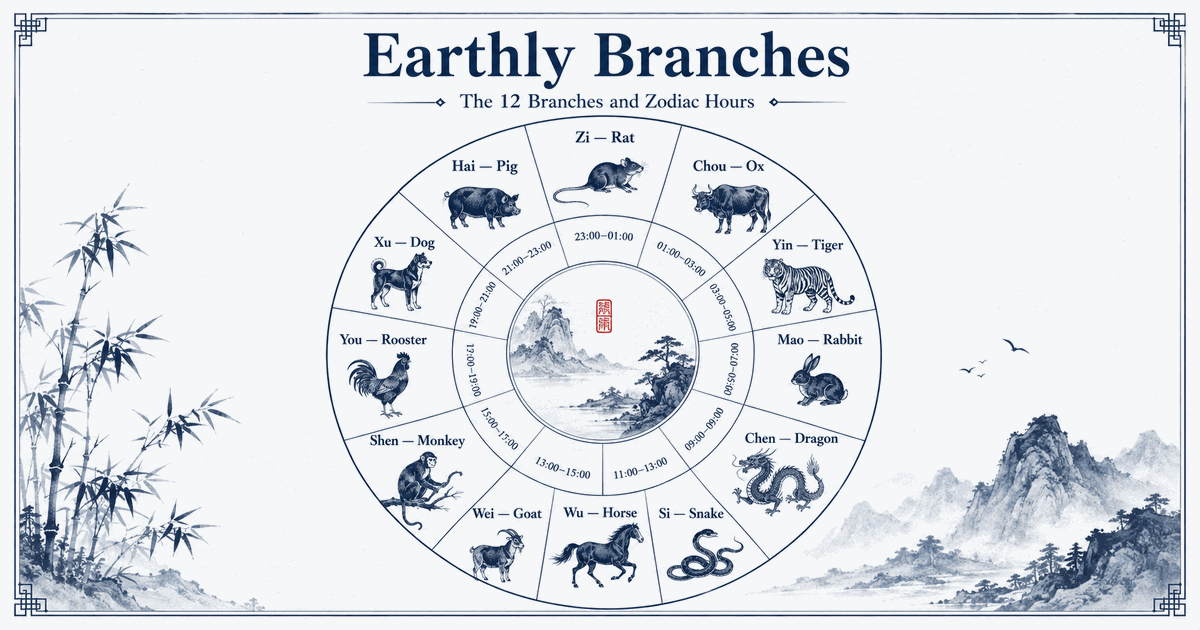
If the Heavenly Stems are the visible top row of a BaZi chart, the twelve Earthly Branches — Di Zhi — are the deeper, rooted bottom row. They are the same twelve signs most people know as the Chinese zodiac animals, but in BaZi they carry far more than an animal: each branch holds a season, a set of hours, an element, and often hidden stems tucked inside it.
The Twelve Branches
| Branch | Animal | Main seasonal quality |
|---|---|---|
| 子 Zi | Rat | Water, midnight, storage |
| 丑 Chou | Ox | Cold earth, reserve |
| 寅 Yin | Tiger | Wood begins, movement |
| 卯 Mao | Rabbit | Wood peak, growth |
| 辰 Chen | Dragon | Damp earth, transition |
| 巳 Si | Snake | Fire rises, intensity |
| 午 Wu | Horse | Fire peak, visibility |
| 未 Wei | Goat | Dry earth, ripening |
| 申 Shen | Monkey | Metal begins, strategy |
| 酉 You | Rooster | Metal peak, refinement |
| 戌 Xu | Dog | Dry earth, closure |
| 亥 Hai | Pig | Water rises, retreat |
Read the table as a wheel of the year rather than a list. The branches move through the seasons — Wood rising in spring (寅卯), Fire peaking in summer (巳午), Metal sharpening in autumn (申酉), Water deepening in winter (亥子) — with the four Earth branches (辰戌丑未) sitting at the turns between seasons. This seasonal logic is where a branch gets most of its meaning.
Why Your Animal Is Not the Whole Story
When people say "I'm a Rabbit," they mean the animal of their birth year — a single branch out of four. A full BaZi chart contains four branches (year, month, day, and hour), plus four stems above them, and each branch may conceal additional hidden stems. That is eight visible characters and several hidden ones, versus the one your zodiac sign captures.
This is exactly why generic zodiac horoscopes feel too broad to be useful: they describe one-twelfth of humanity from a single branch, while a BaZi reading works from the whole chart. Your year animal is a real part of the picture — just not the whole of it.
Four Branches, Four Positions
Year Branch
The public and inherited layer: ancestry, early environment, wider networks, and how the chart first appears from a distance.
Month Branch
The seasonal command of the chart. It carries strong information about environment, work structure, family influence, and elemental strength.
Day Branch
The inner and relational chamber beside the Day Master. It is often read for intimate patterns, daily life, and partnership dynamics.
Hour Branch
The private future-facing layer: output, aspiration, later-life direction, and what develops beyond the visible present.
Hidden Stems
Each branch holds one to three hidden stems — elements buried inside it like roots under the ground. The branch 午 (Horse), for instance, is mainly Fire but hides some Earth within it. These hidden layers often explain motivations or life themes that the visible stems alone do not show, and they are a major reason two people with the same visible chart can still differ.
Hidden stems also decide whether a stem above is "rooted." When a visible stem finds its own element hidden in a branch below, it stands on firm ground and behaves reliably; without that root it floats. Weighing roots this way is part of judging Day Master strength.
Combinations and Clashes
Branches do not sit in isolation — they react with one another. Certain pairs and trios combine to reinforce an element, while opposite branches clash and destabilise each other. These interactions can amplify or cancel what the individual branches suggest, which is why a branch is never read alone. Spotting them is a step above the basics, but knowing they exist explains why a real reading looks at the chart as a whole rather than sign by sign.
A Branch Is Context, Not a Verdict
No branch is good or bad on its own. Its meaning emerges only from the full picture: the season, combinations and clashes, hidden stems, the relationship to the Day Master, and the Luck Pillar currently active. Treated that way, the branches are a rich source of self-knowledge rather than a fixed forecast. The step-by-step method is set out in how to read a BaZi chart.
The animal is the doorway. The branch is the room behind it.