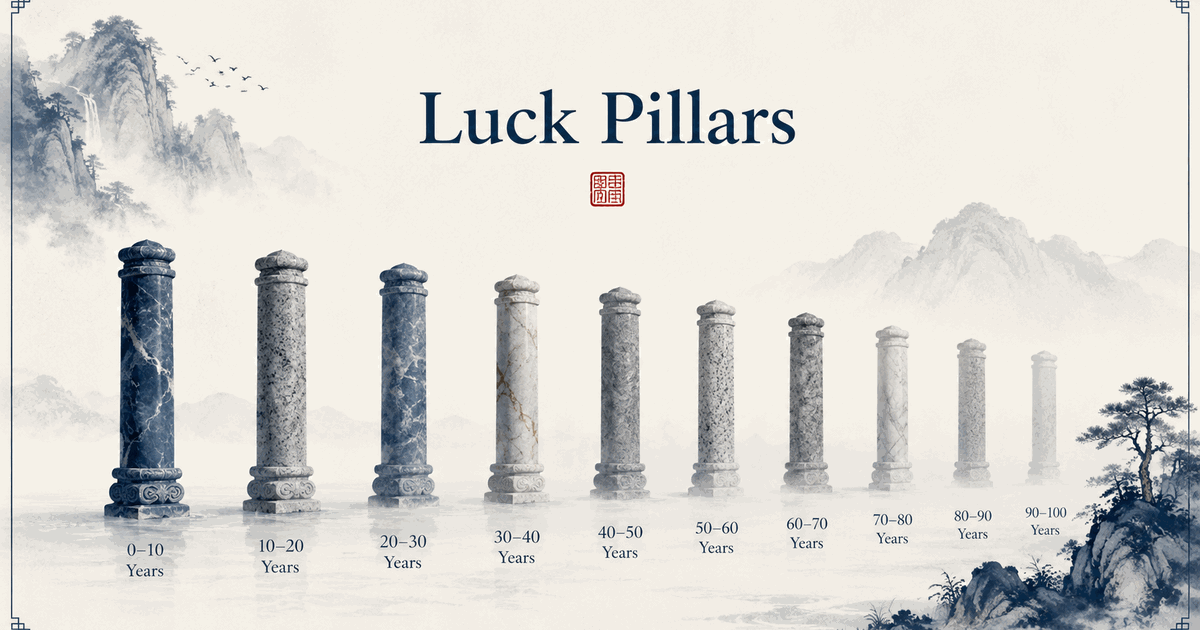
Your natal chart is fixed the moment you are born, but life plainly does not feel fixed — some decades open up, others close in. BaZi accounts for this with Luck Pillars (Da Yun): a slow-moving sequence of ten-year cycles that travel alongside the natal chart and change which energies are emphasised around you. They are how a static chart becomes something you can read across time.
What a Luck Pillar Is
A Luck Pillar is a single stem-and-branch — one Heavenly Stem over one Earthly Branch, just like a natal pillar — that governs roughly ten years of life. It does not replace your chart; it sits beside it and gradually shifts which elements are strong or weak in the surrounding climate.
The pillars are derived from your birth month pillar, then stepped one position at a time along the sexagenary cycle. Each step opens a new ten-year window with its own elemental flavour — a decade that leans Metal, then one that leans Water, and so on. Over a lifetime you walk through a handful of these seasons.
How They Are Sequenced
Two things decide the sequence, and both are worth understanding because they explain why timing is so personal. First, direction: the pillars run either forward or backward along the cycle, determined by the polarity of the birth year combined with the reading's gender convention. Second, the starting age: the first pillar begins at an age calculated from the distance between your birth date and the nearest solar term.
This is why two people born only days apart can enter their cycles at quite different ages and move through them in opposite directions. There is no universal "lucky decade" — the timing is computed from your own chart, which is exactly what makes it meaningful.
Context, Not Verdict
Here is the idea that keeps Luck Pillars honest: a pillar does not rewrite who you are. It changes the weather around a fixed landscape. If a cycle brings in an element your natal chart is short of, that decade can feel like expansion and relief; if it piles on an element you already have in excess, the same years can feel like friction or overload.
Notice this is not prediction of events. It is a shift in emphasis. The chart still describes the same person; the Luck Pillar just changes which parts of them the season calls forward. This is the principle the whole system follows: timing is context, never a sentence about fate.
A Luck Pillar is the season you are walking through, not a script you are forced to follow.
Luck Pillars and the Year
Luck Pillars are the slow layer; on top of them run the annual pillars, which change every year. The two work together — the decade sets the background climate, the year adds a nearer-term weather pattern. A supportive year inside a difficult decade can bring a genuine window; a difficult year inside a good decade is usually a passing squall. Reading them as layers, rather than one flat forecast, is what makes timing useful rather than fatalistic.
Reading a Pillar Honestly
To read a Luck Pillar, look at the element it brings and how that element interacts with your natal chart. Does it support your Day Master or drain it? Does it reinforce something already strong, or restore something missing? A cycle that supplies your favourable element is one to build in; one that overloads the chart is a season to protect and consolidate.
Used this way, Luck Pillars become a planning tool: they suggest when to advance, when to steady, and when to rest — a lens for better decisions, not a script you are forced to follow. To see how timing fits into the full method, read how to read a BaZi chart.