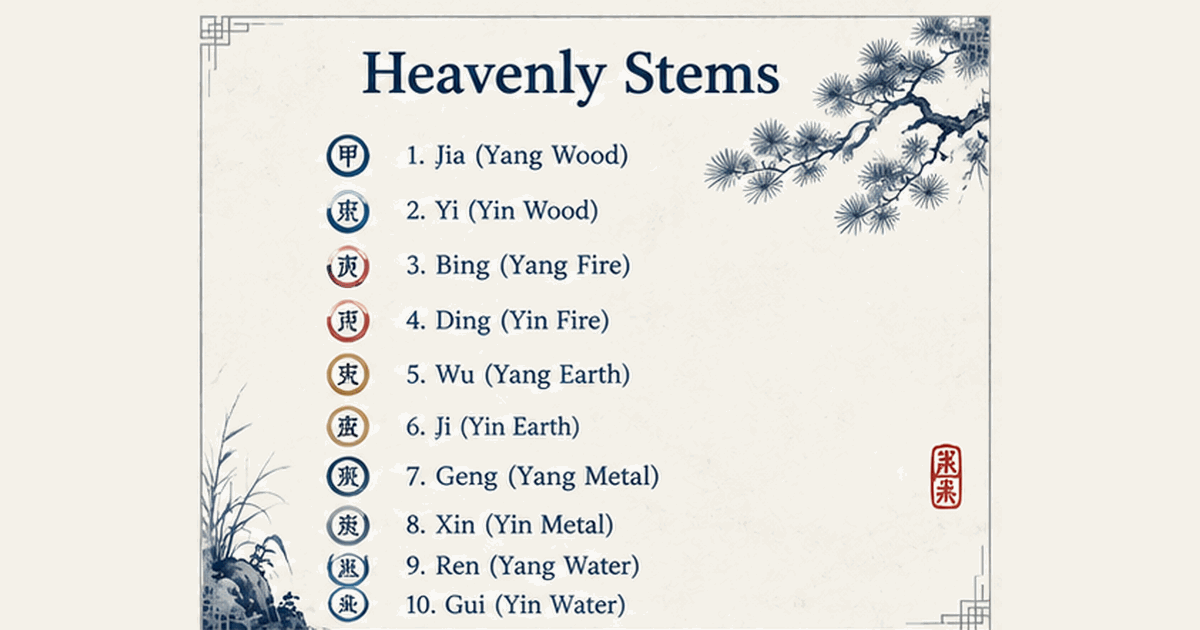
The ten Heavenly Stems — Tian Gan — are the top row of a BaZi chart, and they are the most direct way the Five Elements appear in your Four Pillars. There are exactly ten because each of the five elements comes in a yang and a yin form: two Wood, two Fire, two Earth, two Metal, and two Water. Learn these ten and you have learned the core alphabet of BaZi.
The classical images below — a tall tree, a candle, a mountain — are memory aids, not literal claims. They capture how each stem tends to behave. Yang Wood (甲) stands tall and unbending like a great tree; Yin Wood (乙) is flexible and reaching, like a vine. Same element, two temperaments. That difference in polarity is what makes the ten stems expressive rather than repetitive.
The Ten Stems
| Stem | Element | Classical image |
|---|---|---|
| 甲 Jia | Yang Wood | Tall tree |
| 乙 Yi | Yin Wood | Vine or flower |
| 丙 Bing | Yang Fire | Sun |
| 丁 Ding | Yin Fire | Candle |
| 戊 Wu | Yang Earth | Mountain |
| 己 Ji | Yin Earth | Garden soil |
| 庚 Geng | Yang Metal | Axe |
| 辛 Xin | Yin Metal | Jewelry |
| 壬 Ren | Yang Water | Ocean |
| 癸 Gui | Yin Water | Mist |
Notice how the yang form of each element is bigger, more outward, more forceful, while the yin form is smaller, more inward, more refined. Yang Fire is the sun that lights a whole sky; Yin Fire is the candle that warms one room. Neither is stronger in any absolute sense — they simply work differently, and a chart may want one and not the other.
The Day Stem Is Your Day Master
One stem outranks the rest in importance: the Heavenly Stem sitting on the Day pillar. This is your Day Master, and it represents you. Every other stem, branch, and Ten God in the chart is interpreted by how it relates to this single character.
This is why the ten stems matter so much in practice: knowing whether you are a 丙 sun or a 癸 mist is the first fact a reading establishes, and it reframes everything that follows. Whether the rest of the chart supports or drains that Day Master is the question of Day Master strength.
Visible Energy vs Hidden Roots
Stems sit on top of the pillars for a reason: they show what is visible and easy to name — the qualities a person expresses openly. Beneath each stem sits an Earthly Branch, which carries deeper, seasonal energy and can conceal hidden stems of its own.
A stem with strong support in the branches below it is said to be "rooted," and a rooted stem behaves far more reliably than one floating without support. This interplay — visible stem above, rooted branch below — is a large part of what gives BaZi its depth compared with a one-line zodiac sign.
Stems are the chart's visible language. Branches are where that language grows roots.
Stem Combinations
Like the branches below them, the stems interact with one another. Five classic stem pairs are said to "combine" — 甲 with 己, 乙 with 庚, 丙 with 辛, 丁 with 壬, and 戊 with 癸 — each pairing a yang stem with a yin stem five places away. When two combining stems meet in a chart, their relationship can pull the elements in a new direction, sometimes transforming into a different element altogether under the right seasonal conditions.
You do not need to master these combinations to start reading a chart, but knowing they exist explains why the stems are never just a static list. They lean toward and away from each other, and that movement is part of what a full reading weighs.
Putting the Stems to Work
You do not need to memorise all ten at once. Start by finding your own Day Master and getting a feel for its image, then learn the others as they appear in your chart. The full sequence — from locating the Day Master to weighing the elements and timing — is laid out in how to read a BaZi chart.