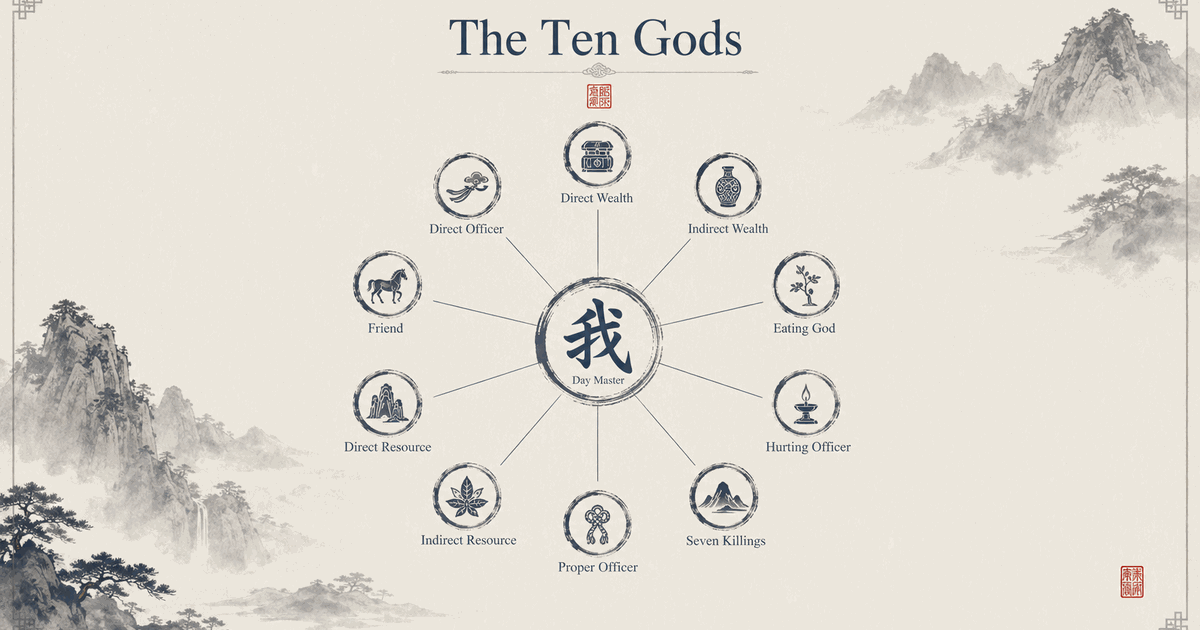
If the Day Master is the centre of a BaZi chart, the Ten Gods are how everything else is read in relation to it. Once you can identify your Day Master, learning the Ten Gods is the step that turns a chart from a static list of elements into a portrait of how a person actually engages with work, money, authority, and other people. This is where interpretation really begins.
What the Ten Gods Actually Are
The Ten Gods (Shi Shen) are not deities and not omens — the translation is unfortunate. They are relationship labels. Each other character in your chart is described by one thing only: how it stands in relation to your Day Master, measured through the Five Elements.
There are exactly five possible relationships, and each splits into two by yin-yang polarity. Five times two is ten. That is the entire system — no memorising a hundred special cases, just five relationships seen from two angles.
The Five Relationships
Everything follows from the generating and controlling cycles of the Five Elements, always measured outward from your Day Master. Ask five questions — what is the same as me, what do I produce, what do I control, what controls me, what produces me — and you have the whole map.
| Relationship to Day Master | Ten God pair | Reads as |
|---|---|---|
| Same element as you | Companion / Rival | self, peers, allies, competition |
| What you produce | Output | expression, creativity, performance |
| What you control | Wealth | resources, focus, what you manage |
| What controls you | Officer | structure, rules, pressure, responsibility |
| What produces you | Resource | support, learning, backing, rest |
A quick way to feel these: if you are a Wood Day Master, other Wood is your Companion, the Fire you feed is your Output, the Earth you part is your Wealth, the Metal that cuts you is your Officer, and the Water that grows you is your Resource. The same logic rotates for every element.
Why Each Splits Into Two
Each of the five relationships appears in two flavours depending on polarity. When the related element shares your Day Master's yin or yang, the relationship reads as steadier, smoother, more conventional. When the polarity differs, it reads as sharper, more forceful, more unconventional.
This is why the classical texts pair a "proper" and an "eccentric" version of each god: Proper Officer and Seven Killings, Direct Wealth and Indirect Wealth, Direct Resource and Indirect Resource, and so on. Same underlying relationship, different temperature. Proper Officer reads as steady responsibility and rules you accept; Seven Killings reads as pressure, challenge, and authority that must be wrestled with.
How the Ten Gods Shape a Reading
Read together, the mix of Ten Gods in a chart describes temperament. A chart weighted toward Output tends to be expressive and creative, often drawn to performance or making things. One heavy in Officer leans toward duty, structure, and responsibility. Strong Resource points to someone who learns, absorbs, and leans on support; strong Wealth to someone practical and focused on what they can manage and grow.
The art is in reading them as a whole rather than one at a time. A little Output plus strong Officer is a very different person from strong Output with no Officer at all — the first is disciplined self-expression, the second can be brilliant but unruly. It is the proportions and the interactions that tell the story.
Tendency, Not Prophecy
It is worth being precise about what the Ten Gods do and do not claim. They describe how you are wired to relate — to authority, to money, to your own creativity — not what events are fated to occur. "Strong Wealth" does not promise riches; it describes a practical, resource-focused temperament and how you tend to handle what you manage.
Held this way, the Ten Gods are one of the most genuinely useful tools in BaZi: a precise language for self-knowledge. To see where they sit in the full reading sequence, follow how to read a BaZi chart.
The Ten Gods are relationships, not fortunes. They describe how you tend to engage — not what the future holds.