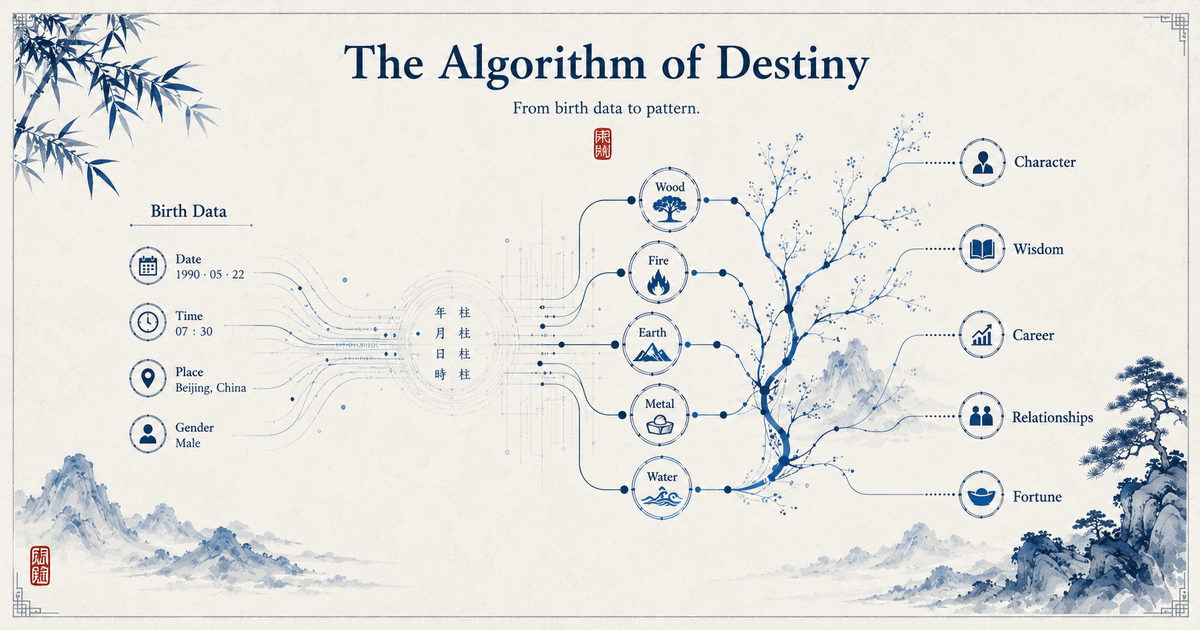
Modern readers often meet BaZi expecting either cold fortune-telling or vague mysticism. Neither quite fits. A more useful frame — especially if you have any background in software or systems thinking — is to see BaZi as an algorithm: a defined procedure that takes an input, applies a fixed set of rules, and produces a structured output.
Calling it an algorithm does not make it mechanical or absolute. It simply names what BaZi actually is: a symbolic system with inputs, rules, relationships, and outputs, refined over many centuries. Seeing it this way strips away the superstition without stripping away the depth.
The Input
The input is a single data point: the exact moment you were born. The system converts your birth year, month, day, and hour into the old Chinese sexagenary calendar, producing the four columns of the Four Pillars. Eight characters in total — this is the raw data the whole reading runs on.
Like any algorithm, the quality of the output depends on the input. A precise birth time yields a complete chart; an unknown hour drops one of the four pillars and makes some conclusions less certain. Garbage in, garbage out applies here as much as anywhere.
The Rules
What separates BaZi from guesswork is that the interpretation follows rules, not mood. The main ones are consistent and learnable: the Five Elements and their generating and controlling cycles, yin-yang polarity, the relationships between stems and branches, hidden stems inside the branches, the Ten Gods, and the Luck Pillar timing cycles.
These rules are what stop a reading from collapsing into random intuition. Two competent readers applying them to the same chart will reach broadly the same structural conclusions, the same way two people running the same function on the same input get the same result. The art lies in weighing the rules together — but the rules themselves are shared.
The Output
Here is where the algorithm analogy needs care. The output of BaZi is not a single prediction of events. It is a map of tendencies: what strengthens you, what drains you, what creates pressure, where you tend to repeat a pattern, and which seasons of life bring certain themes forward.
In other words, it returns a structured description of temperament and timing, not a verdict about the future. Read it as a high-resolution map of the terrain, not a route that has already been decided.
A useful destiny system does not remove choice. It makes choice more informed.
Does an Algorithm Mean Fixed Fate?
It is a fair worry: if the system is a deterministic procedure, does that mean life is fixed? In practice, no — because the output is a pattern, not a command. The chart describes strong tendencies and favourable timing; what you do inside those tendencies is still yours. Knowing you run hot under pressure does not force you to burn out; it lets you plan around it.
This is why the honest framing is self-knowledge, not prophecy. The algorithm makes your patterns legible earlier than trial and error would; the choices remain open.
Why the Analogy Is Useful
The value of thinking algorithmically is that it sets the right expectations. It tells you the reading is repeatable rather than improvised, so two careful readers should broadly agree. It tells you the inputs matter, so an accurate birth time is worth the effort of finding. And it tells you the output is structured, not a horoscope — a description of how you tend to run, which you can test against your own experience.
It also guards against two opposite errors. One is dismissing BaZi as vague superstition; the other is treating it as an oracle that removes responsibility. The algorithm frame lands in between: a rigorous system whose output is a map, read by a human who still has to walk the ground.
The Limits
Any symbolic system can be misused, and it is worth being clear about the edges. BaZi is not a substitute for medical, legal, financial, or psychological help, and a responsible reading never pretends otherwise. It works best as a reflective tool for pattern recognition and timing — a lens for understanding yourself, held alongside real-world judgment rather than in place of it. If you want to see the procedure run start to finish, read how to read a BaZi chart.