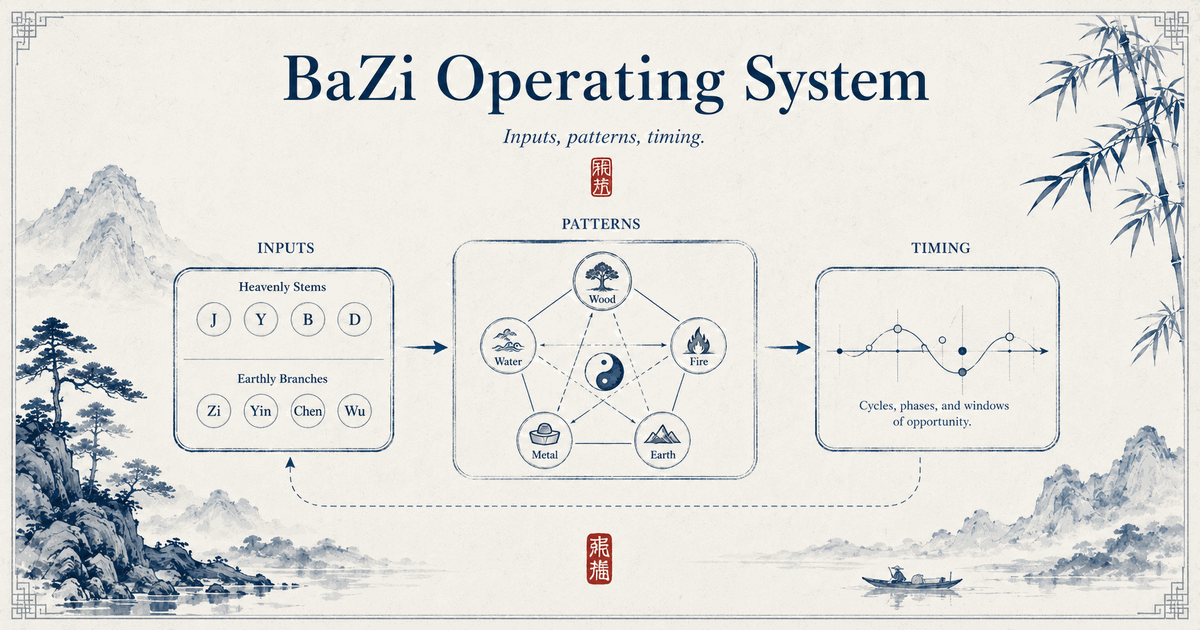
If the algorithm framing describes how BaZi is computed, the operating-system framing describes how to use it. Think of your chart as the OS you happen to be running: a set of defaults for how you seek safety, handle pressure, express talent, and relate to other people. You did not choose it, but once you can read it, you can work with it far more skilfully than by trial and error.
Your Day Master is not a personality box to be filed under. It is the kernel — the centre everything else is interpreted around. The other symbols in the chart describe what gives the system energy, what drains it, what creates load, and what shifts over time.
Inputs and Build
The input is simple: birth year, month, day, and hour. Run those through the ruleset and you get a Four Pillars chart — the compiled build of your system. That build is fixed; it does not change over your life. What changes is which parts of it are active, and how well the environment around it lets it run.
This is the crucial mindset shift: the chart is not a sentence handed down, it is a specification you can finally read. Knowing the spec is what lets you stop fighting your own defaults.
Reading the Defaults
Every chart ships with defaults. It has a characteristic way of seeking security, a way it performs under pressure, a way it handles authority and structure, a way it expresses talent, and a way it relates to money and intimacy. These are not flaws or virtues — they are settings, and most of them are the Ten Gods read together.
Seeing a default clearly is oddly freeing. "I run hot and burn out under sustained pressure" is not a life sentence; it is a known behaviour you can design around, the same way you would tune any system you understood.
Timing as System Updates
The natal chart is the installed OS; the timing cycles are its updates. Luck Pillars and annual pillars do not overwrite the original build — they activate different parts of it, foregrounding one element for a season and backgrounding another. A decade that emphasises a supportive element runs smoothly; one that piles on an element you already have in excess feels like a system under load.
Read this way, timing is context, not command. It tells you which season you are in, so you can choose when to push and when to consolidate.
The point is not to obey the chart. The point is to understand the pattern early enough to choose better.
When the OS Fights the Environment
A lot of everyday friction is not a broken chart — it is a mismatch between your defaults and the environment you have put yourself in. A chart built for depth and focus placed in a role that demands constant visibility will feel drained, and read it too quickly and you might call that a personal failing. The operating-system view reframes it: the software is fine, the environment is wrong for it.
That reframe is practical. Instead of trying to become a different system, you look for settings — roles, routines, relationships — where your defaults are an asset rather than a tax. Much of what a good reading offers is exactly this: matching the chart you have to conditions that let it run well.
Putting It Into Practice
The value of the operating-system view is that it turns interpretation into decisions. A few concrete ways to use it:
- Use the chart to name repeated friction — the same argument, the same stall — as a default rather than a personal failing.
- Use timing to choose when to push and when to recover, instead of forcing every season to be productive.
- Use your favourable elements as a design principle for habits, work, and environment — leaning toward what steadies your chart.
None of this removes choice; it makes choice better informed. To see how the full read is assembled before you apply it, start with how to read a BaZi chart.