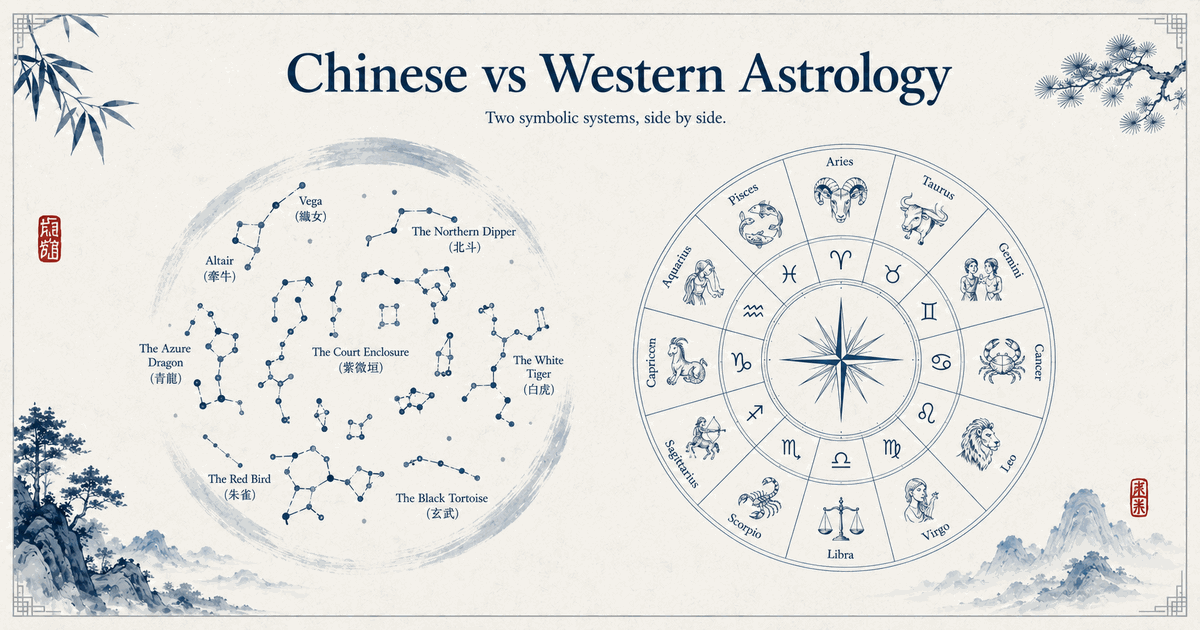
Most people in the West meet Chinese astrology through the twelve zodiac animals and assume it is the mirror image of the horoscope they already know. It is not. BaZi and Western astrology both set out to describe personality and timing, but they are built on entirely different foundations — and understanding that difference is the fastest way to stop mixing them up.
Western astrology begins with planets, signs, houses, and aspects — the positions of celestial bodies at your birth. BaZi begins with the Chinese solar calendar, translating your birth moment into Heavenly Stems, Earthly Branches, the Five Elements, and a Day Master. Both can be insightful; their logic differs from the foundation up.
Western astrology asks where the planets were. BaZi asks what elemental pattern your birth moment produced.
Two Different Maps
A Western natal chart is circular and spatial. It maps planetary bodies around the zodiac. A BaZi chart is column-based. It turns birth year, month, day, and hour into four symbolic pillars.
| Question | Western Astrology | BaZi |
|---|---|---|
| Main reference | Planets, signs, houses | Day Master, elements, pillars |
| Timing layer | Transits, progressions, returns | Luck Pillars, annual and monthly pillars |
| Identity anchor | Sun, Moon, Ascendant | Day Master and chart structure |
Two Different Timing Systems
Both traditions take timing seriously, but they slice it differently. Western astrology tracks the sky as it keeps moving — transits (where the planets are now against your birth chart), progressions, and returns like the well-known Saturn return. The clock is the ongoing motion of the planets.
BaZi instead lays time out in nested cycles derived from your own chart: ten-year Luck Pillars for the season of life, annual pillars for the year, and monthly pillars for finer texture. The result is that BaZi timing is deeply personal — two people the same age can be in very different Luck Pillars — whereas a planetary transit hits everyone's sky at once and is read against each individual chart.
Why the Zodiac Is Not Enough
Many people meet Chinese astrology through the twelve animals and stop there — "I'm a Rabbit," the way one might say "I'm a Leo." But the animal is only your year Earthly Branch, one character out of eight. A complete chart has four branches (year, month, day, hour), four stems above them, hidden stems tucked inside the branches, the elemental relationships between all of these, and the timing cycles on top.
Reducing that to a single animal is like describing a Western chart by its Sun sign alone and ignoring the Moon, Ascendant, and every planet. Useful as a first impression; far too coarse for a real reading.
Sun Sign and Day Master Are Different Anchors
A Sun sign describes one planetary placement. A Day Master is the Heavenly Stem of the Day Pillar and becomes the reference point for every elemental relationship in a BaZi chart. They may echo each other, but they should not be forced into a one-to-one match.
Three Common Misconceptions
A few mix-ups come up again and again. Clearing them makes both systems easier to use.
"My Chinese sign is just my birth year animal." The year animal is one branch out of eight characters. Your four pillars also carry a month, day, and hour animal, plus their stems — so two people born in the same zodiac year can have completely different charts. "BaZi is the Chinese version of my Sun sign." The closest analogue to an identity anchor is the Day Master, not the year animal, and even that behaves differently from a Sun sign. "One system must be more accurate." They answer different questions; accuracy is about which map fits what you are trying to see.
How to Use Both
If you already love Western astrology, BaZi can give a different angle: less psychological vocabulary, more elemental structure and decade-by-decade timing. Use them as two maps of the same territory, not as two systems fighting for authority — and if you want to read the BaZi map properly, start with how to read a BaZi chart.
Further Reading
Start with the Four Pillars, then learn the Heavenly Stems and Earthly Branches. The calculator will show where your own Day Master sits.