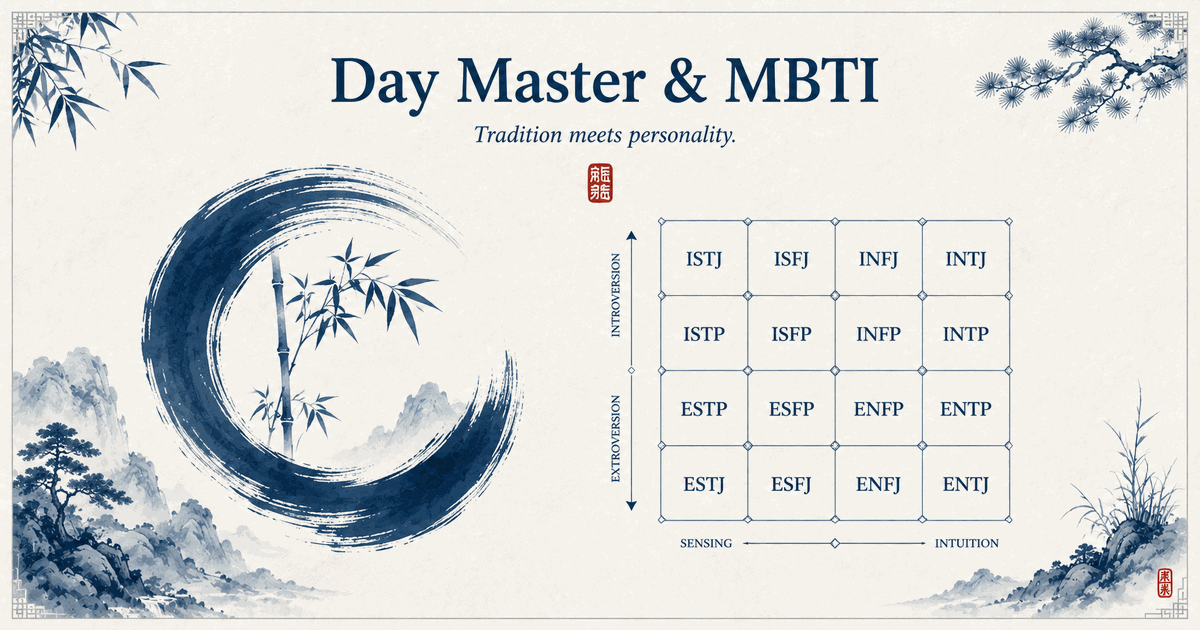
If you already know your MBTI type, it is tempting to line it up against your BaZi Day Master and look for a match. The two can genuinely illuminate each other — but they are built for different jobs, and forcing a one-to-one mapping misreads both. This article uses MBTI as a friendly on-ramp to the Day Master, then shows where the analogy has to stop.
The core difference in one line: MBTI describes cognitive preference, while BaZi describes elemental relationships and timing. A Day Master can feel a lot like a personality type, but the chart is larger than temperament — it also tells you how that temperament shifts across the seasons of a life.
A Gentle Bridge
Yang Wood may feel principled and directional. Yin Wood may feel adaptive and relational. Yang Fire may feel expressive. Yin Fire may feel perceptive. These are useful bridges, but not exact matches.
Comparison Table
| Day Master group | MBTI-like language | BaZi caution |
|---|---|---|
| Wood | Growth, ideals, development | Needs context from chart strength |
| Fire | Expression, warmth, visibility | Can be quiet if Fire is constrained |
| Earth | Support, duty, steadiness | May carry too much responsibility |
| Metal | Standards, precision, refinement | Can soften or harden by chart mix |
| Water | Strategy, intuition, adaptation | May scatter without structure |
Ten Day Master Pairings
Yang Wood
Often resembles principled, future-building types. The useful question is whether the wider chart supports steady growth or creates rigidity.
Yin Wood
Often resembles adaptive, relational types. Flexibility can be a strength, but the chart shows whether adaptation becomes indecision.
Yang Fire
Often resembles expressive, outward-facing types. Visibility is only one layer; season and support determine whether the expression is sustained.
Yin Fire
Often resembles perceptive, focused types. A smaller flame can be precise and influential without needing constant public attention.
Yang Earth
Often resembles steady, duty-oriented types. Reliability may become over-responsibility when the chart has too much containment.
Yin Earth
Often resembles practical, service-minded types. The wider chart shows whether care becomes cultivation or chronic overextension.
Yang Metal
Often resembles direct, standards-driven types. Decisiveness can become inflexibility when pressure is already high.
Yin Metal
Often resembles refined, value-sensitive types. Precision can support craft or turn into excessive self-editing.
Yang Water
Often resembles strategic, exploratory types. Range is useful when the chart also provides direction and containment.
Yin Water
Often resembles observant, intuitive types. Subtle perception needs enough structure to become a clear decision.
Where the Analogy Breaks Down
Three differences are worth keeping in mind so the comparison stays useful. First, MBTI is self-reported from a questionnaire; a BaZi chart is calculated from your birth data, with no self-assessment involved. Second, MBTI gives you one fixed type for life, whereas a Day Master is only the centre of a chart that also weighs strength, season, and the Ten Gods — two people with the same Day Master can read very differently. Third, and most importantly, BaZi adds a dimension MBTI simply does not have: timing.
The Main Difference
MBTI usually stays inside personality. BaZi moves between personality and timing. A person may feel like one pattern in one decade and another pattern in a different Luck Pillar — not because their type changed, but because the season around them activated different parts of the same chart. That movement through time is the real reason BaZi rewards study beyond the initial personality sketch. To see the full method, read how to read a BaZi chart.
Use personality language to enter the chart. Do not let it replace the chart.